
They had to stop for lunch in Barstow and decided to take a chance on Greek. The place turned out to be a bland box of red and white tile, with video screens for ordering, cheap plastic trays, and self-serve stations for drinks, coffee, utensils, even dessert. Rob retrieved pita sandwiches when their number was called. Ellen mopped the last diners’ water rings off the table. A group of bikers filled half of the dining area, dressed in denim and leather, wearing death’s head ear studs and patches on their jackets of the Confederate flag. At the next table over, a Black couple sat in silence, awaiting their order nervously, while their children played games on their phones. A truck pulled up to the building then, an impossibly large pickup truck with chrome mudflaps and a roll bar, a gun rack and a U.S. Marines decal in the back window. Rob’s and Ellen’s eyes met over the pink plastic napkin dispenser, the plastic begonias, the cardboard plates and plastic knives. “We could still turn around,” Rob said, laughing.
But a few hours later they had made it past Las Vegas, and once the mountains turned red at the Utah border, he figured that they had escaped the worst. In St. George they drove past tidy white houses and down a main street of false fronts that could have been on a western movie set, past a hardware store, a coffee shop, a real estate office, a bar. Outside of town, beyond the Costco, the landscape opened out before them, and the highway became a ribbon through wide desert scrubland flanked by long, low mesas that closed in and in and in upon them, until they found themselves in mountain country, driving in the shade of towering red cliffs, with a small river running quietly beside the road. The motels looked so much alike that they missed theirs and had to turn around. But there was wine at the reception desk and a coffee station with espresso, and in their room, terrycloth bathrobes. After bringing in the luggage, Rob made a second trip to the car for the box containing their son Lonnie’s ashes.
“I guess we can’t take him everywhere,” Ellen said, as they put on their coats.
“He’ll be okay by himself for a while.”
It was dark now, but a lighted pathway of manicured gravel ran along the river to the north end of town. In a little shopping mall was a wilderness outfitter and the micro-brewery they were headed for. Ellen wandered off with her glass of sour while Rob talked with the guy behind the bar about the state alcohol limit. The guy had moved from California and knew all the local Los Angeles breweries that Rob was familiar with. “Small world,” the guy said.
“A little tribe,” Rob said, “wandering the earth.”
He found Ellen outside, sitting in the warmth of a patio heater, looking across the river at the Park Service visitor center, closed for the night. “Should we stop in tomorrow, on our way to the valley?” she asked.
“I don’t think anyone would remember him.”
“I guess it was a long time ago, wasn’t it?”
“I’m pretty sure this was his first assignment.”
The next morning Rob found her sitting on the balcony of their room, bundled up tight in a comforter and woolen cap, a manilla folder open on her lap. Beneath them a grassy meadow sloped down to the edge of the river, where a single buck mule deer stood proudly among several does. The sun was beginning to touch the grass, lifting tendrils of steam into the clear, cold air. He zipped his jacket up to his chin.
“You were right,” Ellen said. “This is where he was stationed first. You should read some of these emails. He loved it here.”
“He loved it everywhere.”
“I suppose he must have.”
“He sure never came back home.”
“No, he sure didn’t. Listen to this one.”
Their son’s email described vertical shafts of sandstone two thousand feet high, red but striped across with green where pinyon pine and juniper found footholds in the cliff face. It described water polishing the stones of a river and the cupped leaves of scrub oaks like tiny boats in the current. It described coyotes trotting along the riverbank and bighorn sheep that seemed magnetically attached to the faces of the cliffs.
“He could have been sitting right here,” Ellen said, nodding toward the view.
“What’s the date on that?”
“About twenty years ago.”
“That’s what I thought. The start of his career. If that’s what you call it.”
“He could write, too, couldn’t he?” Ellen said.
“It’s great stuff. I didn’t remember that about the emails. Did you?”
She shuffled through the pages. “No,” she said. “I didn’t remember.”
He brought two extra cups from the coffee bar, into which they scooped as much of Lonnie’s ashes as fit, and secured the lids. They crossed the river into the park where there were a line of tourists speaking scores of languages and a bus to drive them into the valley. They watched for a stop where no one else was getting off, called a late apology up to the driver, stepped down and watched the bus pull away. There was a trailhead across the road. They climbed a few switchbacks until they were hidden from the road, ducked behind a copse of desert sage, and listened for hikers. There was no sound but the wind rattling dry leaves in the trees and scattered birdsong in the scrub. They spread the ashes at the base of an oak tree and stepped back, stood there shifting their feet around in the thick red dust, and said nothing.
That night they had to settle for Thai.
“Tell me again why we’re going to Monument Valley?” Rob said. “He couldn’t have worked there. It’s not federal land.”
“But he loved it apparently. He put it on the list, so . . .”
“So away we go to Monument Valley. To colonize the natives.”
“We’ll sprinkle just a tiny amount.”
“Yeah, sure, tell them that.”
“I was trying to remember,” Ellen said, “the first trip we all took together as a family.”
“New York. Chicago.”
“I don’t think so.”
“San Francisco.”
“That would make sense, but actually, I think it was Paris. I don’t know what we were thinking. He was way too young for something like that. Do you remember? He was bored silly.”
“He was always bored silly. Until he got out here. Go figure.”
“Rob, it’s gorgeous out here.”
“Sure, but at what cost?”
“Don’t be so terrible. Everyone’s been perfectly nice.” But her face changed suddenly. “Let’s not do this right now.” He realized that she’d been hiding a tissue in the sleeve of her jacket. She dabbed her eyes and blew her nose quietly. “Besides, you’re wrong,” she said. “He wasn’t always bored.”
“No, that’s true.”
“He read like a demon. He read almost as much as you. Remember summer vacations?”
“Of course.”
“At the library?”
“Sure.”
“A little stamp on a chart for every book. The other kids didn’t stand a chance.”
“I remember. I taught summers back then, but I do remember.”
“And you couldn’t get him out of my studio for anything. We got him an easel so he could paint right along beside me.”
“He never got the hang of it, though.”
“He was just a little boy. Barely in kindergarten.”
“So what happened to that little boy, barely in kindergarten?”
“The same thing that always happens. The same thing that happens to everyone.”
“Well?”
“He became his own person.”
“Aha! I believe we’ve arrived at the problem.”
Again she slipped the tissue from out of her sleeve.
“I was joking,” he said. He slapped his credit card down on top of the check. Ellen dabbed her eyes and then attempted to refold the tissue, but it was saturated and started to come apart in her hands. With great concentration, she tore the tissue again and again, into smaller and smaller and still smaller fragments, tiny wet bits of tissue paper with frayed little edges, which she stacked on the table between them. Rob sat back in his chair. “Joking,” he said.
The next morning they drove through the back country of the park and then down into brown scrub and that other world of pickup trucks and horse corrals, clapboard houses and sheet metal barns, memorials by the side of the road for the dead drunk drivers of the towns they passed. There was a coffee shop in Kanab serving biscuits and gravy, corn bread muffins and strong, sour coffee. There was a town called Fredonia where Rob and Ellen broke the silence that had carried over from the night before, saying “Where’s Groucho?” almost in unison. They turned east and rose through a forested pass where patches of charred ground alternated with stands of fir and leafless aspen and where, at the highest elevations, a light snow twisted down from the clouds. Coming out of the mountains, they followed the line of a red mesa for what seemed like hours, stopping once at an historical marker for no reason whatsoever. Twenty minutes later, they couldn’t remember what it had said. There was no one else on the road. There might have been no one else in existence. It was as if they were driving on Mars.
Ellen was leafing through the folder of emails. “Why do you think he couldn’t get any of them to stay?”
“We’re talking about the women, I take it.”
“You’d think he could have made it work with one of them, at least.”
“Maybe he didn’t want to. Wife, kids, the whole thing.”
“I don’t know about that,” Ellen said. “Remember Gayle? He brought her to a Thanksgiving. I think he was crazy about her. I was sure they were going to get married.”
“You were his special buddy. What did he ever say about it?”
“Oh, no, I would never ask him something like that.”
“No?”
“God, no. It was none of my business.”
Finally they reached the end of that endless mesa and the road curved gently away. They crossed the Colorado River on a spindly bridge and rose into the higher country of the Navaho reservation, where the land was red once again, and hilly, and they began to see settlements nested in the hollows, small square houses, rusted mobile homes, stick and canvas lean-tos for the horses. It went on this way until the town of Page, just beyond the reservation’s border, where they found a grocery store and stocked up on provisions: salami, cheese, crackers, fruit, and wine, especially wine, as alcohol would not be available to buy on tribal land. Leaving, they took the wrong highway at first and wound up in a vast netherworld of scraped earth and power lines. “Jesus,” Rob said, turning the car around. “Still ugly after all this time.”
“What do you mean?”
“Lake Powell. The dam. That’s where we are. Abbey wrote about it.”
“I wouldn’t have guessed you ever read Abbey,” Ellen said.
It was getting dark. Back on reservation land, the road became more populated as drivers funneled from all directions into the area around Monument Valley. A series of tacky billboards led them to their motel, which stood long and low at the base of a red butte that was lighted up for the tourists. Rob and Ellen checked in, carried in luggage and Lonnie’s ashes, unwrapped plastic cups from the bathroom, opened a bottle of wine. They fell back onto the bed with their drinks.
“Talk about dirty colonizers,” Ellen said a while later. “Why can’t we lay off the booze for a couple days? What’s wrong with us?”
“Do I really have to answer that?”
They were looking across the room at the box of ashes resting on top of the dresser.
“Seriously,” she said, “let’s hide the bottles tomorrow, while we’re out. It’s disrespectful.”
“Fine with me.”
“And we’ll rinse out these cups before we throw them away. And we’ll hide the corkscrew. We’ll put everything in the trunk of the car. I don’t want them to think we’re being disrespectful.”
“I’m sorry, El. The wine was my idea.”
Ellen fished the remote control out of the folds of the bedspread and started clicking through channels, rapidly at first, and then more slowly. And then she stopped.
“I was never his special buddy,” she said.
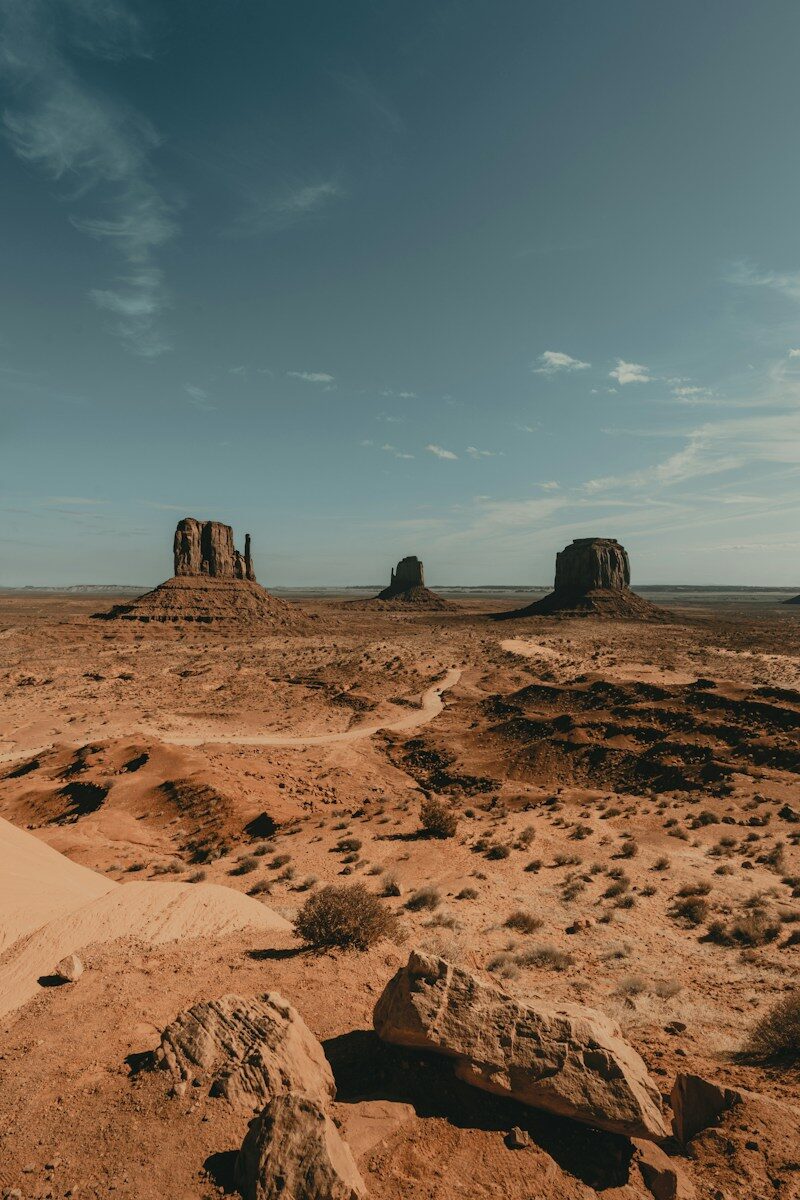
The next morning Rob awakened to find Ellen outside on the patio of their room and in the distance the buttes of Monument Valley, eerily familiar from a thousand photographs. There was a dog of indeterminate breed at Ellen’s feet, lapping up cold cuts from a paper plate. Rob pulled the blanket off the bed and went outside, came up behind her, and wrapped the blanket around her shoulders. She reached back and found his hand. “I still can’t believe he did it,” she said.
The road sloped down from the visitor center at such an angle that Rob lost control of the car, and they slid sideways for a frightening couple of seconds. But at the bottom of the slope the landscape evened, and soon they were on a level path among desert sage and the scattered buttes, chattering over the ruts baked into the hard packed earth of the road. There were cars ahead and behind them, stopping at vantage points designated by the tribe. The further they moved into the valley, the more the cars dispersed, and there were times when they found themselves alone on a stretch of road, though never for very long. They would steer into a turnout, alone, and along would come a minivan, pulling up close beside them, disgorging a herd of noisy children while the parents stood there with map unfolded, pointing into the landscape. At one point they came around a bend to find what seemed like a drag race occurring, until they realized that it was a single muscle car speeding back and forth over a patch of ground with the buttes fading off into a cinematic distance. A young man was on one knee, filming the scene with his phone. Rob and Ellen kept driving. They found a stand selling bottled water, sat in the car and studied the map and watched tourists pay five dollars to have their picture taken on horseback where John Wayne had stood. There seemed to be a spur off the main road another mile or two along the circuit. By the time they reached the cutoff, the wind was whipping up dust until the sky was no longer blue, but crimson. They drove to the end of the spur and waited. After twenty minutes, the wind was even worse. “The hell with it,” Rob said and got out. Ellen followed. They looked around to make sure they were alone, stood with their backs to the wind, and shook Lonnie’s ashes from two Styrofoam cups. The ashes disappeared into the dust-filled sky.
Back in their room, they drank wine and napped, watched television, fed the stray dog and drank more wine, and once it was dark, they walked through drizzle to the motel restaurant. The next morning in the distance the buttes were frosted with snow and the dog was at the sliding door, pawing at the glass.
They drove for an hour under purple clouds and then snow started falling, a light snow that spun around the car and gathered into ice in the corners of the windshield. They entered the park at the quiet east entrance and followed a road that paralleled the southern rim of the canyon. Even in that weather, there were cars at every turnout. They stopped once at a promising spot, where a single SUV was parked at a trailhead, but a quarter mile in, tramping through snow, their toes burned with the cold, and there was no sign of the canyon itself. They turned back, got warm in the car, consulted their phones. Near the visitor center, the road seemed practically on top of the cliff’s edge. They drove there and found a parking place and walked a hundred yards to a scenic overlook. The snow was still falling. The opposite rim of the canyon, the river a mile below them, the land that rolled off at their feet, all of it was a haze, as if seen through a pane of frosted glass. They sat on a bench and pretended to drink coffee until the few tourists in the area wandered away, and then they quickly walked to the edge of the canyon and emptied Lonnie’s ashes into the void.
In Sedona they took a suite in an otherwise modest bed and breakfast, with a great room and kitchen upstairs, an oversized bedroom below. Both floors opened onto balconies above a creek that was yellow with the fallen leaves of cottonwoods. It was the day before Thanksgiving, almost evening when they arrived. They brought in their bags and what was left of their son, perhaps two cups worth of ashes in a crinkled plastic bag tucked inside of a cardboard box that was worn now from all the opening and closing. Two cups meant they were right on schedule.
They were too tired to expend much effort finding dinner. Across the street was an English-style pub where they sat at the bar and ordered pints and burgers. In spite of the predominance of tourists in the area, this was obviously a bar for locals, and it felt like Barstow all over again. Signage covered every inch of wall, jokes about women that could have been written in the fifties, plaques extolling the virtues of automatic weapons, a chalkboard listing beers and adding, “No religion, no politics, no Mexicans.” But everyone in the place—from the guy next to Ellen who denigrated his wife in explicit terms, to the woman next to Rob who thanked the lord above that she had “escaped” California—everyone treated them like long lost friends.
The next morning a football game mumbled through the wall as Rob sat in front of the picture window, reading in fits and starts. When he went downstairs to check on Ellen, she was sitting up in bed, looking through the emails.
“I’m trying to put together a timeline,” she said. “I had it all mixed up in my head.”
“He quit the Forest Service and joined the Park Service. Why, I can’t imagine.”
“No. It was the other way around. He went from the Park Service to the Forest Service. In one of these he says something about the bureaucracy.”
“Another federal job, but with less bureaucracy? That makes a lot of sense.”
“It was just a mention. He wasn’t writing very often by then.”
“Do you want some coffee?”
“I guess we should have known that something was going on. He was writing less and less, and when he did, there’s nothing there.” She picked up a few of the messages as if to indicate the absence of content. “He was barely writing at all, in fact.”
“I don’t know,” Rob said. “I’ll go make us some coffee.”
He went upstairs, made two cups, brought them down and sat on the edge of the bed. “You can read those things forever,” he said, “and we’ll never really know what he wanted.”
“It’s not a secret. He loved the landscape, and he loved the people. He wanted to be outside, not stuck in an office. Even if it’s an office full of books, on a college campus.”
“Thanks a lot,” he said.
“You shouldn’t have taken it personally, Rob.”
“I didn’t take it personally. But is that really what it says in there?”
Suddenly he thought she might cry. “I don’t know what it says in here.”
“Then we’re back where we started.”
“For God’s sake, you think, just because we wouldn’t want to live in a place like this . . .”
“I know.”
“You’ve got to let it go.”
“I have let it go. I’ve let all of it go.”
“It’s obvious you haven’t. And it really seems like you don’t even try.”
“Watch me, Ellen. Here I am, letting it go.”
He made a theatrical exit intended to draw laughter and felt like an idiot. Back upstairs, he tried to read but couldn’t keep his mind on his book. He opened a beer, though it was barely eleven, and found a game on television. Ellen came upstairs.
“Football?” she said. “You’d make a good regular at that bar across the street.”
He gave her the finger, and she kissed his hand.
“Fried or scrambled?” she asked.
“Eggs, fried,” he said. “Brain, scrambled.”
They had grown so used to their routine that they barely talked on the way out of town. The road into the National Forest where Lonnie had ended his career followed a river that was shaded densely and without a break by pines, oaks, cottonwoods, and on either side, towering above them, the red cliffs that they’d grown accustomed to. Wherever the canyon widened, a lodge appeared with one of the usual names, Riverside Inn, Shady Pines Lodge, Oak Tree Motel. There were campgrounds and picnic grounds and trailheads with parking. They stopped at the first turnout where there were no other cars and set off. The river was close by side of the road, but they needed cover, so they walked upstream over sand and rock and the decomposing trunks of fallen trees until they came to a spot where the river slowed and formed a glassy pool with a small, sandy beach, invisible from the road. They sat on a boulder and rested with the box of Lonnie’s ashes between them.
“It’s a good spot,” Ellen said.
“Yes, it is.”
“Beautiful. Peaceful.”
“Yes. Very.”
She breathed in deeply. “Okay, then.”
They carried the box to the edge of the water and knelt in the sand. They opened the box one flap at a time, revealing the plastic bag containing the last of the ashes. Ellen grasped the bag by its mouth, and Rob supported the weight from below. Together they held the bag over the surface of the water and allowed the ashes to trickle out slowly. The ashes swirled in the twisting current of the pool and moved across the water away from them. At the far end of the pool, where the current picked up, the ashes were pulled into the faster water that was tumbling downstream, over boulders, out of sight.
They had dinner a ten-minute walk from the bed and breakfast. They ordered a second bottle of wine and tossed around the idea of a vacation in Rome and Florence as soon as the school year ended in May. On the way back to their room, a little drunk already, they stopped at the English pub for a nightcap and wound up dancing to a band playing songs from the sixties and seventies. The pool table had been moved to a corner of the room and covered with a sheet of plywood on which were several chafing dishes. Someone told them to dig in, and they realized that it was Thanksgiving dinner for anyone who wanted it. They had stuffed themselves at the restaurant, but Rob took a small helping of everything anyway, and Ellen nibbled off his plate.
The next morning, waking early, and only a little hungover, he found that he was able to read again. He took coffee downstairs two hours later. Ellen was lying on her side, the covers pulled over her head. Around her on the bedspread lay the emails tossed about in a disordered mess. “Sleeping?” he whispered. When there was no response, he left the coffee, and after another couple of hours, he went to the office of the bed and breakfast and arranged a late departure.
They packed without speaking, drove without speaking. Once they had left the valley around Sedona, the mountains lost the red color that they had started to take for granted, and finally there were no mountains at all. The land was flat, brown, parched, ugly. There were high voltage power lines draped over the freeway, cookie-cutter housing behind stucco walls, shopping areas surrounded by scrub, truck stops bigger than small towns. They miscalculated and wound up hungry in the middle of nowhere and had to stop at a gas station with a mini mart. They bought little plastic containers of crackers, pepperoni slices, and trail mix, and sat outside, at a metal table bolted into the concrete, like the tables at a prison.
“I read every message a thousand times,” Ellen said, “and I still have no idea why he did it.”
“I’m sorry,” Rob said. “I had to give up trying.”
“Did you ever try? Yesterday you didn’t even want to talk about it.”
“I really did, yes. Why he came out here, why he stayed. Why he did what he did. I tried to understand, but in the end, it’s impossible, so why keep knocking your head against a wall.”
“Well, anyway,” she said, “that’s not really the problem.”
“What are you talking about now?”
“The problem isn’t that we don’t know why he did it. The problem is that we never knew him to begin with.”
“Come on, El.”
“But even that’s not really the problem.”
“Oh, for God’s sake. What’s really the problem, then?”
“The problem is that we never wanted to know him.”
He stood, gathered the plastic and crumpled napkins from the table, walked into the mini-mart, threw everything in the trash. He came outside and walked straight to the car. “Three more hours,” he said. “Let’s go.”
He got in the car, started the engine, fastened his seat belt, adjusted the heating. Ellen had to knock on the window to be let in.
“You’re wrong,” he said, throwing the car door open. “By the way.”
It was the same landscape over and over, four lanes of highway through dirt and tumbleweed. Every so often a road sign would announce the presence of a town some miles ahead, but when they reached the exit, there would be no sign of life, only a road disappearing into the nothingness of the desert, and sometimes an abandoned gas station. Rob had to keep telling himself to loosen his grip on the steering wheel. His knuckles were white, and his palms were burning. “You’re wrong,” he said after thirty minutes of driving. “You’re wrong,” he said, thirty minutes after that. He pulled off the highway at one of those broken-down service stations and ducked into the bathroom. Graffiti covered the walls, the mirror, the towel dispenser, the fluorescent lights, the filthy sink and filthier toilet. He screamed as loudly as he was able to for as long as he could hold it.
“You’re wrong,” he said when he got back to the car.
They reached the distant suburbs of Los Angeles, where the ugliness of the desert gave way to the more familiar ugliness of urban sprawl. The traffic thickened and slowed. They passed shopping malls, car dealerships, construction sites, cemeteries, housing tracts, billboards. They passed a road sign for the university where they had met and started dating. Ellen found the local public radio station but immediately turned down the volume.
“I didn’t mean it,” she said.
“I know,” Rob said.
She turned up the radio. It was a show they listened to every week at this time, a locally produced show on art, food, and culture. The hosts were discussing the restaurant scene in a part of town that was rapidly gentrifying, not far from where they lived.
“Italy will be nice,” she said. “Let’s definitely do Italy in the spring.”
John Rosewall attended the writing program at the University of California, Davis. A musician as well as a writer, he was a member of seminal Los Angeles bands The Last and Trotsky Icepick, and is currently a member of Petrified Max and The Wretched Edsels. He lives in Pasadena, California.