
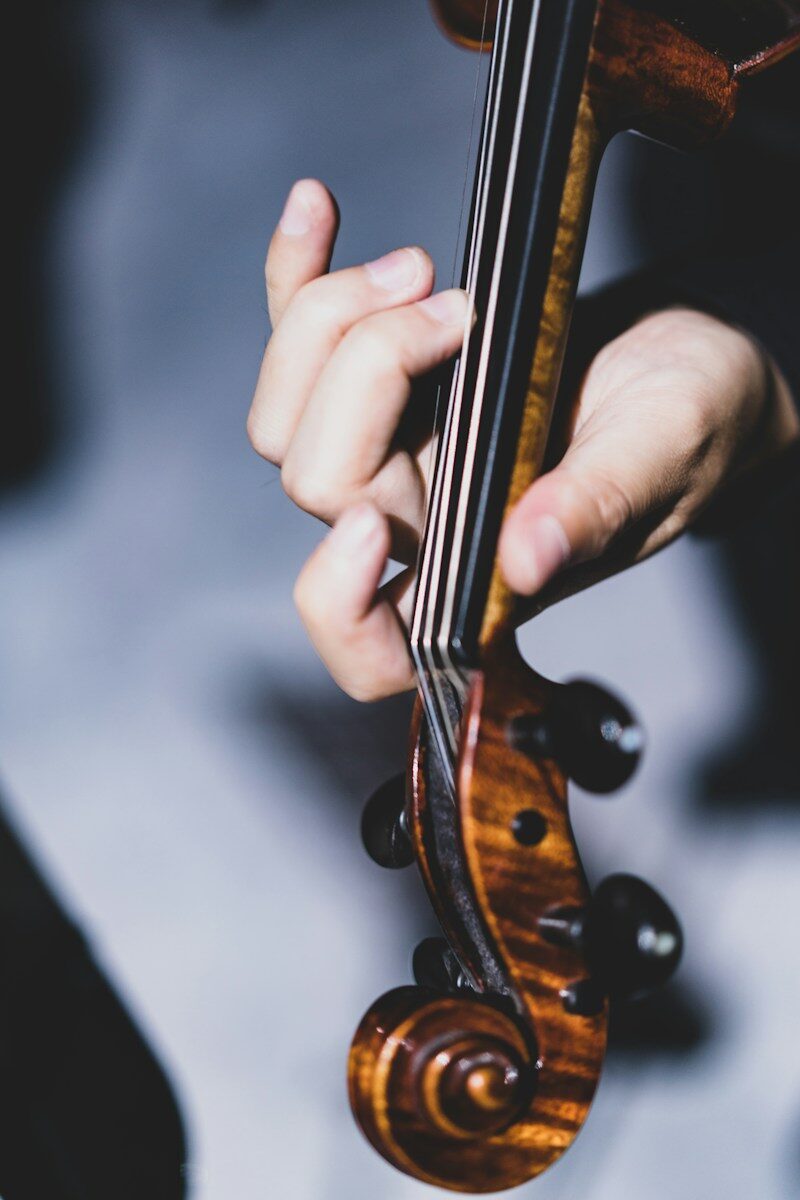
The string quartet had gathered in Boris and Tanya’s living room for a celebration. For the past year the four musicians had been playing lunchtime concerts at libraries all over the city. Besides Boris, on the cello, there was Efim, a slight, taciturn man with heavy lidded eyes who played the viola, and Anna and Igor, a couple, both violinists in their late twenties. Tanya didn’t play an instrument, but she was the one that brought the group together. Joining them at the table was Ilya, Tanya’s brother, who fancied himself the group’s manager.
It was late June, and though the windows were open the room felt hot, even stifling.
Tanya had escaped to the kitchen, using the dishes as an excuse to get a minute for herself. She had expected a quieter evening, the musicians dissecting the performance, heaping praise on each other and telling funny stories about on-stage mishaps from the past. That was how she remembered her husband and his friends celebrating in the past. But she also knew that her brother had gone out the day before and gotten a bottle of vodka, so what could she expect? Once she realized what kind of evening it was going to be she sent her sons, Sasha and Sergey, to their room. No need for them to sit through a night of drinking.
In the kitchen, the water rushing into the sink muted the clinking of classes, the shouting of cheers. She would have gladly spent the rest of the night washing dishes.
But now it would be rude to stay away any longer, and she came back out.
The room grew quiet. On the table Tanya saw a half-eaten plate of herring, pickles, and a nearly empty bowl of potato salad she’d prepared the day before. Ilya had a half empty bottle of vodka in his hand. He had been about to pour another round when Tanya came back in. Igor and Anna looked at Anna. Efim seemed to be asleep. Boris was seated at the head of the table, with his back to the entrance. He turned around slowly. He looked confused, as if he couldn’t remember his wife ever getting up from the table. He was wearing the white shirt Tanya had ironed for the performance, but it was open down to his chest. There were beads of sweat on his forehead and on his nose.
“Tanya! Taniusia! My beauty!” He threw his arms out wide, inviting her for an embrace. “Well, come over here. I was just about to raise a toast.”
The musicians, and Ilya, stayed quiet, waiting for Tanya’s reaction.
But Tanya knew what was expected of her.
“Well, pour me one then!”
“Hurrah,” said Ilya.
A year earlier Igor had walked into the hardware store where Boris worked the stockroom and the key-cutting machine, and where Ilya had gotten part-time work at the cash register. Igor had come in to copy keys for the apartment he and Anna had just rented, and Ilya chatted him up while Boris did the work.
“What’s that you got there, a violin?” Ilya asked, pointing to the case in Igor’s hand.
“That’s right.”
“You make a living playing that?”
“My wife and I teach at the Lucy Moses school. Between that and private lessons, we get by.”
“Boris, you hear that?” Boris did not hear the conversation over the buzzing and grinding of the machine, but he nodded anyway.
“My brother-in-law, over there, was the principal soloist of the Leningrad Philharmonic!”
“First cellist,” Boris corrected Ilya as he handed over the keys.
“No kidding!” Igor was genuinely impressed. “My wife and I are thinking of putting together a quartet to play weddings. The pay is pretty good. Four hundred dollars for four hours work. And we’d split it four ways.”
But Tanya would have none of it.
“You’re going to play while these rich people stuff themselves? While they talk and get drunk instead of listening to the music?”
Boris shrugged and got up from the table.
“You’re a little fool,” Ilya said to his sister.
“Stay out of it!” Tanya hissed back.
Ilya had been living with his sister and her family ever since coming to the country, two years earlier. Somehow, he still occupied their bedroom, while Tanya and Boris slept on a fold-out couch in the living room. Ilya knew that he irritated Tanya, and yet every time he suggested moving out, Boris, her husband, would say “stop that nonsense, Ilya. Find a real job, get on your feet, and then worry about finding a place.” But so far the only work Ilya had been able to find was the part time gig at the hardware store.
Tanya felt her brother wasn’t looking very hard, but whenever she tried to bring this up he would insist that the problem was his English, and the recession.
“This George Bush,” Ilya, who read every issue of the Russian paper cover to cover, would say. “He defeated communism, but he’s going to end up destroying capitalism too. And you wonder why I can’t get a job?”
In any case, though he wouldn’t admit it, Ilya was nervous about living alone and preferred to stay with the family, even if he knew his sister was starting to resent him.
A few days later, walking past the local library, Tanya saw a flier for a mid-day piano concert.
“My husband is cellist,” she said to the middle-aged woman working the counter. “Can he have concert here?”
“Have him call the central office,” the librarian said, and wrote the number on a slip of paper.
Without waiting for her husband to come home, Tanya called up Anna and invited her and Igor over for dinner.
“I want you to form an ensemble,” she said to Boris. “And not for weddings. Play chamber music for people who actually care.”
Boris grumbled. “They’ve found a way to make some money. Why should we get in the way?”
He’d more or less come to terms with the fact that his career as a musician was finished; they should have taken away the cello along with his old passport. So what? He’d stock shelves and grind keys so that his sons would do something better with their lives. He could live with that. Tanya’s periodic attempts to revive his artistic life felt like an intrusion, but he was never good at saying no to her. A wedding quartet – now that was an idea. A way to earn some extra money. But not something he could do without her approval.
The dinner went off well. Ilya stayed unusually quiet, and even got up to clear the plates, telling his sister to sit. Tanya and Anna did most of the talking. Anna and Igor had emigrated as teenagers, and met while auditioning for Julliard. They’d gotten married right after graduation, and had just given up their studio in Manhattan for a two bedroom in Midwood, not far from Anna’s parents. Both had filled in with a series of orchestras – Chicago, Philadelphia, San Francisco (all cities that sounded as exotic to Tanya as New York had several years earlier) but nothing had translated into a full-time gig. Now they were both thirty, Anna explained, and at some point they wanted to have kids, and they would want their parents close by.
“Well?” Tanya asked, bringing the conversation back around. “So how about it? Play the libraries, get yourselves known, and you’ll get invitations for even better things.”
Tanya had planned all of it out in her mind, and now she laid her vision out for her husband and the guests. There were sure to be some serious lovers of classical music coming to these mid-day concerts, especially the ones at the Manhattan branches. Some of them would have connections to managers and to recording companies. After a while they would branch out, play at Trinity Church and some of the other chamber music venues. Soon enough they would be playing Carnegie Hall! And in the meantime, they’d have a bit of a supplement to their income. It wasn’t like they’d be working for free.
“And do you know?” she said, finally. “I read that many of these libraries were built by people like Andrew Carnegie. You know, and the Rockefellers. The same people who built Carnegie Hall, and the Metropolitan Opera, and all the great concert halls in this country. So the libraries must have amazing acoustics. It will be good practice!”
“I didn’t think you had it in you,” Ilya said to his sister afterwards, while she was washing up in the kitchen.
“What’s that?”
“The sales pitch. The inspirational speech.”
“Oh leave me alone.”
That evening, as Anna and Igor rode a nearly empty bus back to their place in Midwood, Anna asked Igor what he made of the evening, and of Tanya.
“I don’t think she really understands how things work.”
“No. Rockefellers! Carnegies!”
They both laughed.
“But I like her enthusiasm. And if Boris is really that good it would be nice to play together, see if anything comes of it. We can always play weddings.”
The fourth member of the quartet, Efim, was recruited by Anna and Igor from the music school. At the first rehearsal, which took place at Boris and Tanya’s apartment, Efim shook Boris’ hand and said “I heard you played with the Leningrad Philharmonic. I had a chance to play with them too, you know, but I wanted to stay in Odessa.”
That was, generally, how Efim spoke.
“I heard Oystrakh play when he came to the USSR. I wasn’t impressed. Oh, he’s good, but so good you’re going to wait in line for tickets?”
But Efim was a professional, there was no doubt about that. He came to rehearsals prepared, knew the music, and had a calm demeanor that set everyone else at ease. Though he was older than the other musicians he never leaned on his seniority. When he did comment on the way others played, what he said was always brief and on point.
It took only a few sessions for the quartet to gel. Three nights a week they would gather at Boris and Tania’s place, run through their warm-ups, and then practice as an ensemble.
Tanya sent a homemade demo to the booking office of the New York Public Library. A dozen calls later she had set up their first gig.
At first, the quartet only played one or two shows a month. Before long, the bookings picked up. The owner of the hardware store, was sympathetic, letting Boris make up the hours in the morning, or in the evening, or by working weekends. Ilya filled in during the hours Boris was away. When he wasn’t needed at the store Ilya tried to make himself useful to the quartet. One time he shlepped Boris’ concert clothes and his cello all the way to the Bronx. Another time Ilya showed up early at a library in lower Manhattan, and to the great confusion of the staff, introduced himself as the group’s manager and began setting up chairs.
Sometimes the quartet played to nearly empty rooms, the few people in the audience confused and elderly library patrons.
“If I wanted to play for the dead,” Efim said after one such performance, “I would have taken my fiddle to the Jewish cemetery.”
“Yes,” Boris retorted. “But would the dead give you fifty dollars for an hour’s work?”
“Well,” Efim agreed. “When you’re right, you’re right.”
But other times they played to a nearly full house, and members of the audience would approach them afterwards to offer their appreciation. Boris had a hard time following what was being said; he smiled and bowed awkwardly. But, heading back to the hardware store, he’d think “Tania, as always, was right.”
One night, Igor and Anna took the train all the way up to the upper west side, to meet their friends Philip and Grace at a bistro they had all gone to as students. The four of them had been close as undergraduates. Philip and Grace had started dating right around the time that Igor and Anna got together, and that alone set them apart from the others in their cohort, who largely avoided long-term relationships. All four were diligent musicians, and bookish, too. Grace’s parents owned a grocery in Astoria, so she was a New Yorker like Igor and Anna, but Philip had grown up in Connecticut.
As they rode uptown, Anna thought of the time Philip had invited all three of them to his parents’ house. Grace had pulled Anna aside when they met up at Grand Central.
“Don’t be shocked. I was, when I first went there. But his parents really are pretty nice.”
Despite the warning, Igor and Anna were stunned.
That night, after a dinner with Philip’s parents that had been prepared by one maid and was served by another, Anna whispered to Igor “I keep worrying that I’m going to put something in the wrong place.”
The next night, Philip’s parents invited another older couple that lived down the road, and they asked Anna and Igor to play after dinner. Anna had never been as nervous on stage as she was playing in that Connecticut living room. Her hands felt clammy, and when she rested the violin against her neck she could feel a vein throbbing against the wood. Later, in bed, Igor had to reassure her that she hadn’t embarrassed herself.
But she couldn’t get enough of the salty air when they went for a walk along the Long Island Sound, their feet bare in the cool sand. She didn’t know that you could be hungry for air, but that was how she felt every time she took a breath. Like a greedy child suddenly given an infinite supply of her favorite treat.
Now it had been almost two years since Igor and Anna had last seen their friends. Philip and Grace had residencies around the country and in Europe and toured in between. Igor and Anna received postcards. From Berkeley, from Hanover, New Hampshire, from Helsinki and Madrid and Tanglewood. Sometimes they were signed by both Philip and Grace and sometimes by one or the other.
“It’s hard,” Grace said at dinner. “We’re lucky if we’re together three months of the year. But that’s just what it takes, I guess.”
For a moment the table grew quiet. Then Anna said:
“Well, we’ve been performing, too. We’ve got a quartet with this amazing cellist from the Leningrad Philharmonic.”
“No kidding!” Philip said.
“That’s wonderful!” Grace echoed.
Before Igor could say anything, Anna went on.
“Yes, and you know what? We’re playing a lunchtime concert this week. If you guys are still in town, you should come!”
The concert was at a library in downtown Brooklyn. There were fifty chairs set up, and with Grace, and Philip, and Ilya, only ten of them had filled by noon. Anna had regretted the invitation right after she had made it, and as the quartet took their places she was near panic. Although the building had an imposing neoclassical facade, the room itself made Anna think of a poorly run hospital. The tables had been pushed aside, revealing a linoleum floor spotted with ancient, dried out, gum. The windows, which seemed to be sealed shut, were so grimy that the cheerful spring sun came through dramatically weakened. The steam heat was, inexplicably, going at full blast, even though it was late March and the temperature outdoors was in the low 60s, and it seemed to her like the hiss of the radiators was drowning out their playing. Throughout the concert Anna was conscious of her own tension, of cramps in her fingers and sweat dripping from her armpits. The violin sounded flat, and she kept trying to adjust the tuning between each pieces. Efim was either falling behind or rushing ahead, and even Boris’ cello sounded sluggish.
“That was really nice,” Grace said as soon as the show was over.
“Yes, well done,” said Philip, shaking hands with each member of the quartet in turn.
Anna hated them in that moment. She wished that Philip and Grace had just spoken the truth, had called her out for even agreeing to play in such a pathetic space. In music school they had all been quite direct with each other. That was painful, sometimes, but preferable to this polite condescension. She couldn’t wait for Philip and Grace to leave, to pack up and be back in Midwood, to throw off her sweaty concert dress and climb under the covers.
On the train heading back to the city, Philip and Grace were silent. For the moment they were staying with Philips parents, but in a week they would be off again – he would head on a two-month tour of Europe, and she had a residency in Montreal. How much longer could they do this? He was good looking, and rich, and she had no shortage of invitations to drinks or dinner or coffee when she was on the road. Her own parents were getting older. Philip’s parents were rich enough that such things didn’t matter, or mattered less, but hers were not and besides she was an only child and her father and mother would need help sooner or later.
When they were at Grand Central, waiting for the New Haven train, Grace turned to Philip and said: “Don’t you think it would be nice to be a bit more rooted? Maybe we could try to find a way to spend more of the year in the city.”
Philip smiled but didn’t respond. Instead he withdrew his hand and cracked his knuckles one by one, as often he did when looking at a challenging piece of music. Just then their train was announced and he took Grace’s hand and led her to the platform.
That evening, Anna said to Igor: “I don’t think we can do this anymore.”
Ever since the rehearsals had started, Sergey and Sasha had gotten used to staying in their room when Igor, Anna, and Efim came over. Or they’d go and play cards with their uncle.
Now that the quartet was having a party, and their mother and uncle were there with the guests, Sasha was resentful.
Sasha asked his brother: “what’s going on out there?”
Sergey was playing Tetris. Theoretically the game belonged to both brothers. But there was little that Sasha could do when his older brother wanted to play except to complain to his parents, and that meant a worse beating later.
“Just a party,” Sergey answered, without looking up or taking his thumbs off the console.
“So why can’t we go out there?”
“We can. It’s just boring. Here, you can have this for the rest of the evening.”
Sergey tossed the Tetris over to his brother. He pulled out a book and began to read, and the laughter and declamations coming from the living room soon became background noise they could both easily ignore.
In the living room, meanwhile, Boris was pouring another round.
“I want to raise a toast to my wife!” Boris declared, slamming his fist on the table, so that the glasses jumped up like a troupe of Cossack dancers, and the lone remaining herring flipped to the other side of the oval serving plate.
Efim woke up with a jerk and picked up his glass even as Boris was refilling it. Igor and Anna looked at Boris, expectantly. When the bottle was empty Boris placed it under the table.
“Friends, tell me!” Boris began. “Tell me! Who besides Tanya could have made all of this happen? Look at us, now, playing for a year, in some of the best venues of this great city. In libraries built by Carnegies and Rockefellers! Say what you will about those people, but they cared about culture. Yes, they made their money in business, in railroads and coal mines, but they knew when to stop and put it into making the world more beautiful. But who were they compared to my Tanya? Tanya, who got us together, who made it so we could play music.”
Here he paused, and, carefully keeping the glass upright, brought his forearm up to wipe the sweat off his face.
“I mean,” he continued. “Yes. Sure. Not many people may come to our concerts. But this is a problem with the public. And when people do, they are old. I don’t mean any offense, Efim. It’s just, well, some of them are like this.”
Boris threw back his head, closed his eyes, and opened his some mouth.
“It’s true!” said Efim.
“And some are like this.”
Boris pitched his head forward, so that his chin rested on his chest, and his left arm hung limply at his side.
“Yes!” Efim concurred. “You could have been actor!”
“But still! I think somewhere deep inside they probably hear the music we are playing.”
“It’s true.” Ilya chimed in. “Scientists say that even patients in a vegetative state can benefit from…”
Boris slammed his fist on the table.
“Be quiet, Ilya! I’m raising a toast to your sister.”
Ilya stopped mid-sentence, and his lower lip hung helplessly.
Boris paused, as if he was searching for a line he needed to get right before moving on.
“Anyway,” he said finally. “Let’s drink to my beloved Tanya.”
Boris raised his glass up to his lips, and everyone did the same. Then he threw back the Vodka. Efim stabbed the last piece of herring with his fork, then guided it into his mouth. Igor coughed and held his fist next to his lips. Tanya sighed, stood up, and began to gather the empty plates.
“Wait!” The voice was Igor’s. Tanya froze, a half-dozen dirty plates in her arms.
“I too want to raise a toast. To Anna.”
“Yes,” Efim said. “Go. And then I’ll raise a toast to my dead wife.”
Tanya sighed and rested her arms on the back of her chair, but did not sit back down.
“My wife. Anna.”
“Go on!” Boris encouraged Igor, pouring another round from the nearly empty bottle.
Anna giggled, then looked over at Tanya and grew quiet.
“She’s really remarkable.” He paused and closed his eyes. “You see. She could be. Anywhere. But. She wants to be here. And I am here. And we will stay here. Forever. And that is good. Really. It’s good.”
“Oh my god,” Anna said, to no one in particular.
“That’s it.” He said. “That’s all I wanted to say.”
“Good man! To Anna!” Boris threw back another shot, as did Efim. Igor managed to drink half and looked like he was going to be sick.
Anna stood up and followed Tanya into the kitchen.
Boris, meanwhile, pressed his hands into the table, and, pushing against it, stood up. Steadying himself with the backs of the chairs, he made his way around and plopped down next to Ilya.
Boris threw his arm around his brother-in-law.
“Ilya, I’m sorry I yelled at you. But, you know, I love Tanya very much. And I love you too! And I respect you.”
Boris had turned his face and was looking intently at Ilya, though it seemed that great effort was required for him to hold his head up.
“I know you do,” Ilya said. “I know.”
“And do you respect me? Hey Ilya! You respect me don’t you?”
“Of course I do!”
“Then let’s drink!”
“To you!”
“No, to you!”
“To the Rockefellers and the Carnegies!”
But there was no more vodka, a fact that Boris accepted only after checking every corner of the table with his eyes.
“Damn it all,” Boris said, and fell silent, his arm still hanging limply on Ilya’s neck.
In the kitchen, Anna offered to help Tanya with the dishes.
“That’s OK, Anna,” Tanya waved her away. “You must be tired. I’ll do this quickly.”
But Anna stood by, awkwardly handing dirty plates to Tanya.
“Listen, Tanya. I need to tell you something. We already told Boris earlier today. We’re going to form a quartet to play weddings, like we talked about a year ago. Igor’s got a cousin who knows all about these things, and he’s going to help us out. We hope Boris joins us, but we understand if he doesn’t want to. Or you don’t want him too. Our friends who made it as musicians, they are on tour six months of the year. The thing is, we want to have kids, like you, and we want to move into a bigger place, maybe even buy a house. You understand, don’t you?”
Tanya said nothing. Anna stood next to her, but when all the dishes had been washed and dried she went back into the living room and told Igor it was time to head home. Igor tapped Efim on the shoulder. The violist sat up with a start.
“Come on, Efim. Time to go.”
To Boris he said “don’t get up.” Boris grunted in response.
Tanya came out of the kitchen to see the guests out.
“Thank you Tanya,” Efim said. “You’ve been a wonderful hostess.” He bowed, then took her hand and kissed it. His lips were wet, which she would normally have found disgusting, but his grip on her hand was appropriately gentle. Something about the old man’s courtliness, despite the vodka he’d consumed over the course of the evening, changed her own mood.
Tanya smiled. Suddenly she felt a sense of regret, but she wasn’t even sure about what.
“I’m sorry I kept disappearing into the kitchen,” she said.
“You have nothing to be sorry about, my dear. I never did raise that toast to my wife. You remind me of her.”
“Next time.”
“Yes,” Efim agreed. “Yes. Next time.”
Then turning to Igor and Anna, he said, “come on, young people,” and led them out the door.
And Sasha, realizing the living room had gone quiet, came out to investigate. He found his father asleep on the couch, snoring loudly. Confused by the sight, he took his father’s winter coat from the closet and draped it over him.
“Go to sleep,” said Tanya. “And don’t forget to brush your teeth.”
She would have liked to go to sleep herself, but Boris had collapsed without unfolding the couch. Instead, Tanya turned off the ceiling lights, leaving only a small reading lamp. She didn’t see her brother standing near the kitchen door.
“Why don’t you go sleep in the bedroom, and I’ll stretch out here on the floor?”
But Tanya waved him away.
“That’s the last thing I need. You sleeping on the floor and catching pneumonia.”
Ilya shrugged and slunk off to the bedroom.
She hadn’t told Ilya that that Igor and Anna were going to form a wedding band, that the quartet was in all likelihood finished. Yes, she wanted her brother to get a real job, and to stop pretending he was managing a quartet. But Ilya, too, would be disappointed that the quartet was going to stop performing. He, too, would wonder what it was he was doing in this country.
Tanya made a cup of tea and sat holding it at the table. To her own surprise she felt good. Of course she’d been cross with Anna, at first. Tanya had worked pretty hard to get the group its first bookings, and she was sure if they stuck with it long enough they’d start playing real venues, just like she had first envisioned. But, Tanya admitted to herself, she already had what Anna wanted, or what she said she wanted. Six months of touring a year. That was no way to have a marriage, let alone a family. Then again, having children, a family, that wasn’t so easy either. But Anna would find that out for herself.
The house was quiet now, and Boris was snoring peacefully.
Let him sleep, Tanya thought. Later I’ll shake him awake and make him help me with the couch.
Artemy M. Kalinovsky is the author of A Long Goodbye: The Soviet Withdrawal from Afghanistan (Harvard University Press, 2011), and Laboratory of Socialist Development: Cold War Politics and Decolonization in Soviet Tajikistan (Cornell University Press, 2018). His short stories have appeared in Cetera, Nachtljocht, and The Write Launch.