
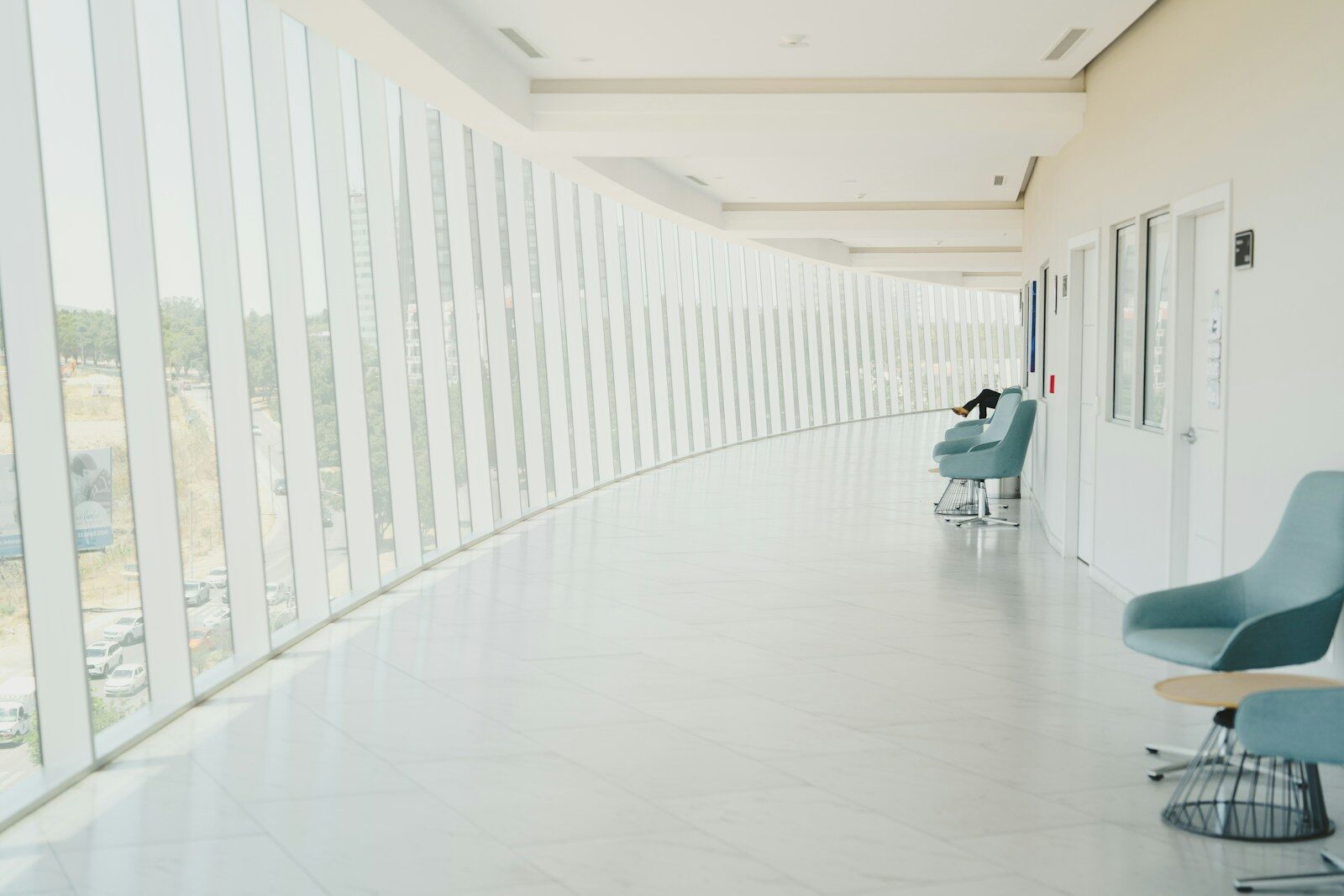
The face of the nursing home glares at me through dozens of blank eyes reflecting onto the parking lot. The eyes judge me, silently asking, “Why didn’t you come see him earlier?”
It’s a fair question. Most daughters would’ve seen their father at least once in the past two years. But I’m not most daughters, or rather, my father isn’t most fathers. A brief sting of annoyance pricks me when my phone rings. I press speaker. “Yes?”
The calm voice of my older brother, Mark, echoes in my car. “Nancy? Are you almost here? I’m not sure how much longer he has.”
“Almost. Ten more minutes,” I lie. I hang up and peer at the building of many eyes, wondering which one holds my father.
I bend my forehead to the steering wheel, close my eyes, and take slow breaths, attempting to ease the albatross of dread – my constant brooding companion whenever I contemplate my childhood. My hold on the wheel is so fierce that my knuckles gleam light pinkish white. I sit back and shake out my hands while tipping my head toward the roof of the old Honda Civic.
The inside of my car is a tapestry of my life. The headliner over the driver’s seat bears mascara scars I’d inflicted putting on makeup while driving. The passenger seat still shows the faded yellow splatter of the cereal my daughter spilled as I drove her to high school. She’d cleaned the seat, but the sour whiff of old milk hangs in the air like a ghost of her teenage years. Speckles of dried blood paint the back seat, witness to my son’s broken nose. The fuzzy dice my husband won at miniature golf dangle from the rearview mirror, jockeying for space with my Port of Los Angeles parking pass. Our rescue dog’s wiry black hairs linger in the crevices of the gearshift and blanket the threadbare upholstery. As I look around the car, warm family memories wrap their arms around me. I close my eyes and savor the embrace, imagining myself transported back to the familiarity and security of my home.
My phone’s jarring ring jerks me violently from my reverie. “Yes, Mark?” I don’t attempt to hide my lack of enthusiasm.
“Are you here, Nancy? Please hurry.”
“I’m coming. Two minutes.”
I look at the building and say out loud, “You’re tough; you can face him.” Then, before I can change my mind, I leave the comfort of my car and trudge toward the entrance under the building’s watchful eyes. A thick layer of pine needles covering the asphalt causes me to slip and skid as I make my way uncertainly across the parking lot. A cool fall breeze filters through the massive trees that flank the structure, carrying with it the faint smell of pine sap. As the scent wafts across my face, it brings me back to my childhood yard, and I frown, bowing my head into the wind.
At the reception desk, a woman with shuttered eyes and a shrunken-apple face mutters, “One minute,” without looking up from her computer monitor. When she pulls her gaze from the screen, she purses her lips and scrunches up her already wrinkled nose as she eyes my ripped jeans and old sweatshirt. “Who are you here to see?”
“David Carlson.” I read her name tag. Mavis. Sounds about right.
“Carlson, Carlson,” she mutters as her long fingernails click-clack on the keyboard.
I wait for Mavis to find my father’s record, taking in the well-worn furniture, faded paint, and rattle and hum of the heater pumping excessive amounts of hot air into the claustrophobic, stuffy lobby.
Mavis squints at the screen, “Here he is – Memory Care ICU Wing. Family only at this stage,” she says, dismissing me with a wave of her fingernails.
“I’m his daughter.” I twist the pen chained to the counter in circles to avoid eye contact.
“Oh, so you know the way to his room then?”
I focus on the pen as if it’s the first time I’ve held one, mumbling, “No. I’ve never been here.”
“Oh, but he’s been here . . . I see.” Mavis compressed her lips into a line so tight that her mouth eventually consumes them. Then she releases her trapped lips and peers at me over her glasses. “Name please?”
“Nancy Carlson,” I murmur, looking away to escape her enmity.
Mavis gives me a saccharine smile and holds out a visitor’s badge with my name on it. “Your father is in 305. Take the elevator to the third floor, then turn left.”
I slap on my badge while I walk toward the elevator and clamp a hand over my nose when the medicinal odor lingering in the lobby floods my nostrils. This is the scent of the waiting room I sat in while my mom endured her surgeries. The smell invariably evokes death for me. To my left, an elderly man inches forward with the help of a walker. His head is bowed, whether with effort or the inability to raise it, I can’t say. His bathrobe swings free over grey sweats that hang loosely on a skeletal frame. His hands, a map of liver spots, grip the walker with their remaining strength. His feet slip in and out of stained house shoes as he shuffles past me in measured time.
The elevator doors shimmy open, revealing an orderly clad in white scrubs standing next to an elderly woman with pasty skin lying on a gurney. She’s hooked up to a ventilator, and her eyelids are fixed shut with white surgical tape. She appears to be comatose, or at least what I imagine comatose to look like. A soiled sheet covers her gaunt body. The orderly glances up from his phone, flashes me a toothy smile, and asks, “Going down?” as he chews on an overly large piece of gum I can see rotating in his mouth.
I offer him a polite smile. “No, going up,” I sigh, relieved that I don’t have to share the elevator with them. The doors clang shut, and I jab the call button several times, then text my brother, “Almost there.” After a short wait, the elevator doors stutter, then open. I poke my head inside tentatively and sniff, recoiling at the residual smell of the patient who was just ushered out. But Mark is waiting for me, so I board the elevator, press “3,” and hold my breath, as if that will protect me from the death loitering in the confined space.
The doors open on the third floor, and I jump out, gasping for breath. My brother paces outside the elevator, drinking coffee and holding onto the stethoscope looped around his neck. When I leap from the elevator, coffee splashes onto his formerly immaculate khakis and salt-white button-down shirt. His Mercy Hospital ID badge swings on the lanyard around his neck as he jerks backward. He looks at me with raised eyebrows while wiping coffee from his chin, then he looks down at his coffee-splattered cordovan loafers and back at me. “What the heck, Nancy?” He gives me a fleeting side hug. “Why are you panting?”
My cheeks flush as I give him a sheepish look. “It’s nothing. Sorry about that.” Then I cinch my arms across my chest. “How’s Dad?”
“I just consulted with the staff physician. The pneumonia’s caused respiratory failure, so Dad’s on a ventilator,” Mark says as he tosses his cup in a trash bin. “Unfortunately, the worsening pneumonia has also brought on hypoxia.”
“Translation please?” Mark’s use of medical jargon always confounds me.
Mark holds up his palms. “Right. In layman’s terms, his organs are shutting down and a machine is breathing for him.” He rubs bloodshot eyes with his knuckles, then drops his hands to his hips. “Dad’s conscious, but we don’t know how much time he has. His doctor’s surprised he’s made it this long,” he says as we walk toward Dad’s room. “The nurse is changing his sheets now, so we have a few minutes.”
We sit down on an ancient vinyl couch with cracks like varicose veins, pushing aside the blanket of discarded magazines with torn pages and missing covers. I scan the hallway littered with gurneys and wheelchairs and listen to the distant hacking coughs of the residents echoing off the dreary walls. A nurse with a limp and sloping shoulders smiles at me as she hobbles past, dragging one foot and carrying a tray of beige food to an unfortunate resident. The warm, stale air reeks from the malodorous scent of unclean bodies. The geometric grey wallpaper, yellowed in patches, curls away from the walls at the seams and corners as if repelled by what’s going on in the rooms beyond.
Mark interrupts my silent assessment of our surroundings. “How long has it been since you’ve seen Dad?”
My eyes fix on my scuffed sneakers. “Since that night.”
“You haven’t seen Dad in two years?” Mark makes no attempt to disguise his shock. His gaze burns my cheek.
My brows draw together in an involuntary scowl as I turn to face him. “You weren’t in the ER that night. Dad broke three of her ribs, and her face was so battered, she was unrecognizable.”
Mark bows his head and frowns, then says into his lap, “You know what his childhood was like Nance. He’s got a lot of baggage.”
I bite down on my anger, stand and face my brother. “I’m so sick of your excuses for his behavior. Mom had two surgeries after he beat her that night.” I gesture toward Dad’s room, “Do you know he claimed she did all that to herself?” Mark turns away at this, unable to defend him or meet my gaze. I shake my head. “I can’t forgive him or listen to you rationalize his behavior.”
Mark sighs, stands up, and wraps his arms around me. My spine stiffens and my torso muscles contract. I don’t want to be convinced that I should let go of my resentment toward my father. Mark and I were both painfully aware that Dad abused Mom off and on throughout their marriage. I can still smell the inside of my toybox, where I would hide and pretend that I couldn’t hear the blows, hoping to be spared. My fear of the dark is inextricably linked to hearing my mother cry out while I was inside that pitch-black box. From a young age, I learned to pay attention to warning signs; empty beer cans meant a storm was brewing and it was only a matter of time before something set Dad off. Mom had a reprieve from his violence when his drinking abated during their 60s and 70s, but shortly after Dad turned 80, he beat her beyond recognition, and I insisted she move in with me.
I raise my palms to Mark’s chest and push him away. “No. Dad almost killed Mom. I have nightmares about what he did to her.”
Mark collapses onto the sofa, and it groans in protest. He rests his elbows on his knees and holds his head in his hands.
I lean my forehead against the window and gaze at the patchy grass on the front lawn, thinking of our mom. She’d just applied to law schools when she met my father but was pregnant with Mark by the time she received her acceptance letters. If my devoutly religious grandparents hadn’t pressured Mom into getting married and raising a family instead of pursuing a career, her life would have been radically different. Dad’s ego was threatened by her superior intellect, and he used force to establish his dominance. Mark and I hadn’t escaped his wrath either. The only means of discipline Dad understood was the belt, which he yanked from his Wrangler jeans whenever anger overwhelmed him. I’d always thought of my dad as someone who felt life had let him down and was determined to reduce everyone around him to his level of discontent.
I turn watery eyes to Mark. “Should we have gotten Mom out of the house sooner?”
Mark considers the question with a pained expression on his face, then shakes his head. “We asked her. She said they wanted to live together, and it’d been 20 years since he’d hit her. I’ve consulted with two neurologists. They said Dad’s dementia likely caused his regression into violence.”
I squeeze my eyes shut and curl my hands into tight balls. Why is Mark always making allowances for Dad’s behavior? What about our childhood – is Dad not responsible for that either?
Mark approaches the window and places a warm hand on my balled-up fist. I pull my hand away without looking at him.
Mark shifts away from me and says, “I know you think I’m soft on Dad. But as a doctor, I see patients come to terms with past mistakes as they approach the end of their life, so I suppose I’ve developed compassion for those regrets.” He puts a hand on my shoulder. “He wasn’t all bad. Don’t you remember any good times?”
I pull my shoulders inward and wrap my arms around my ribs. Mark stares at my profile, patiently waiting for me to speak.
There had been some loving moments – Dad building a loft in my bedroom and a swing set in our backyard. He’d shown he cared through acts of service, but it always came at a high price. My childhood was spent tiptoeing around the outskirts of my father’s rage, guessing at what might set him off and doing my best to avoid it. But after Mark left for college, Dad focused all his anger on me, and I dropped out of school and left home to escape it. Thankfully my boyfriend’s family took me in, and I earned my G.E.D., but I often wonder what I’d be doing if I’d grown up in a stable and supportive environment rather than a home filled with fear and uncertainty. I’m confident I wouldn’t be driving a forklift for a living. I turn to Mark. “A bedroom loft doesn’t make up for all that we went through.”
A nurse in pink scrubs with a salt-and-pepper crew cut emerges from Dad’s room carrying soiled sheets in tattooed arms and says, “All done.”
“Thanks,” Mark says before he turns to me. “You have every right to be angry.” He gives me a pointed look, “But I think Dad’s been waiting for you to get here to let go. This will likely be the last time you see him, Nance.”
I nod and let out a quivering exhale. Don’t chicken out now; you can do this. I follow my brother into Dad’s room, and as I cross the threshold, I choke on a scent redolent of decay smothered by antiseptic cleaners. I cough as I adjust to the stench, made more potent by the room’s stagnant air.
Mark moves to the side, and I suck in my breath at the sight of Dad lying in the hospital bed. He’s so frail. The father of my youth had been muscular and vital, with a thick mustache and a full head of dark wavy hair. This man’s body seems to have collapsed on itself. A thin sheet covers the lower part of his spare frame, and his skin loosely drapes his bones. He can’t weigh more than 120 pounds. His skeletal body is propped up by several pillows. An air tube protrudes from his slack mouth, secured to his cheek with surgical tape. Sensor pads adhere to his chest, and a mass of tubes and wires encircle his arms and torso like snakes. His hair has thinned along with the rest of him, and the skin on his once tan face is sallow and covered in grey whiskers. The intermittent beeping of a heart monitor and the continuous mechanical whooshing of his ventilator pierces the room’s stillness.
Dad’s hospital gown hangs open at the neck, exposing his sunken chest. Although his pectoral muscles have withered, I spot the edges of the lion and gazelle tattoos Dad got when he served in the Marines. I eye the shriveled tattoos and remember playing in the above-ground pool Dad built. On summer afternoons, after Dad had downed several beers, he’d ask if I wanted to see the lion chase the gazelle. Then he’d flex his giant chest muscles, alternately making them rise and fall while I giggled and splashed in the pool. Now, Dad’s chest is concave, and his once burly arms are emaciated, with thin blue veins spreading out like spiderwebs under his paper-thin skin. I put a shaking hand up to my mouth. Am I ready for this?
Mark takes my hand and whispers, “He’s sleeping. The linen change probably took a lot out of him. Let’s let him rest for a bit.” Mark leads me to the bedside, as one would guide a child. He picks up a chair, positions me in front of it, then pushes on my shoulders until I collapse onto it. I pull the chair closer to the figure in the bed, who only vaguely resembles my dad.
I look at my father’s inert, bony hands draped on the stark white sheet. His flesh is almost the same color as the linens. It’s impossible to believe these are the powerful hands that gripped and whipped the belt with such ferocity. I envision the way he would approach me, wrapping the belt around his fist and pulling it taut. I hold my hand up to his and think of the one time I spanked my son. He had been kicking the back of my car seat relentlessly, and despite my repeated warnings, he continued to kick the seat as fast as he could with both feet. The seat backing was spare, and his five-year-old feet were pummeling my back with surprising force. My father’s rage rose in my chest like a familiar flame. I squinted my eyes, peering in the rearview mirror, and told my son he would get a spanking if he didn’t stop. He continued kicking in earnest, pounding away on my lower back. After a fierce kick, I said, “That’s it!” Those words stopped him, but it was too late. I followed through on my promise when we got home.
Afterward, the sound of my son’s crying assaulted my ears, and my gut twisted in pain. My rage became acid burning my stomach. I sprinted to the toilet and threw up bile. Slumped against the toilet bowl, I trembled as my own childhood played out behind eyelids squeezed shut against the reality of what I’d done. I saw myself following in my father’s footsteps, and the trajectory of my family life under that tyranny horrified me. I rinsed the bitterness from my mouth and told my husband I would never spank our kids again, and I haven’t. It wasn’t easy, but I’ve worked hard to ensure my children didn’t grow up with the fear and pain that was woven throughout my childhood.
I place my hand next to Dad’s, and I’m taken aback by the vitality of mine and the frailty of his. All my life, his hands were instruments I feared. Now they lay impotent, attached to the feeble body of a dying man. My father couldn’t hurt me now if he tried. I lean into his restless slumber and whisper next to his ear, “I’m not afraid of you anymore.”
Mark circles the bed and lays a gentle hand on Dad’s shoulder. “Dad, Nancy is here to see you.”
My father’s eyelids flutter as he struggles to open his eyes. He lifts hooded lids to reveal jaundiced orbs and turns them toward me. He blinks as the cogs in his brain whirl, slowly processing who’s sitting next to him. Then he raises a shaky hand off the bed and reaches for me.
The tube in his throat prevents him from speaking, but I detect a new emotion blooming in his eyes. Tears begin to trickle down the seams of his weathered cheeks, dropping to his sunken chest in wet blobs. This is surreal. My whole life, I’ve never witnessed my dad showing vulnerability. Although I’d sensed at times that he loved me because he did things to make me happy, I’ve never heard him utter those words aloud.
I fold his outstretched hand in my own. His skin is still sandpaper-rough, but the bulging callouses he’d developed building homes have faded. As I hold his hand, a muffled sob emerges from his obstructed throat.
I can’t reconcile the image of the intimidating, raging man who raised me to this defenseless soul in front of me. Everything about him is faded except his eyes, which blaze with intensity as he pulls on my hands.
My dad’s lips retract into a grimace around his breathing tube, and waves of wrinkles ripple on his cheeks. His glassy eyes do the pleading his voice cannot. He tugs on my forearms. I allow myself to be drawn toward him and meet his rheumy gaze.
As this once proud, stubborn man whose life was defined by rage attempts to express regret without words, images of my mother’s bruised face and bandaged ribs appear unbidden before me. I push back from my father, remembering the fear and pain that plagued our family at his hands. Suddenly, I’m inside my toybox, listening to glass shattering, blows landing, then her cries. I close my eyes and pull inside myself, seeking shelter from the searing memories. Loyalty to the memory of my mom actively pulls me away from him, resisting his plea. His eyes had been so unforgiving when they bore down on me as a child. Why should I forgive him now when he never showed me that grace?
Then I think of my own children and remind myself why I came here. I need to forgive him even if it hasn’t been earned, or I’ll never be free of resentment,. I’m determined not to tread the same road as my father. I don’t want to be angry or alone at the end of my life. My dad’s legacy of anger will die with him.
I open my eyes and look at what remains of my father, and instead of seeing the rage that was the undercurrent of my childhood, I see regret. I take a deep breath, and a heaviness in my chest releases. “It’s okay Dad. I forgive you.”
He takes a shuddering breath and compresses his eyes into slits. Wrinkles fan out from his eyes, and he squeezes my hands with his waning strength.
I turn to Mark. “Can they do anything to make this easier for him?”
Mark shakes his head. “Dad’s already getting palliative care. I’ve guided countless patients through this passage; this is just how it is at the end.”
I turn back to my father, who strains to breathe through the ventilator that renders him mute. Our roles have reversed; now he’s the one who needs me. As his chest struggles to rise and fall, I incline my torso to hold him while Mark holds his hand. Time seems to slow down, keeping pace with my father’s breath. Slowly, gradually, his chest stops rising to meet mine. I turn questioning eyes to my brother, who places his stethoscope on Dad’s chest, closing his own eyes as he listens for a faint heartbeat. Then Mark shakes his head, drapes his stethoscope around his neck, and reaches his fingertips up to tenderly close Dad’s eyelids.
The nurse rushes in, throwing the door against the wall with a bang that shatters the stillness. He sidles up next to Mark and puts two fingers to Dad’s neck. As the nurse feels for a pulse, Mark circles around the bed to take Dad’s feather-light hand out of both of mine and place it gently on the bed.
The nurse picks up the sheet, drapes it over Dad’s head, and puts a hand on my shoulder. “I’m sorry for your loss.”
Dad had requested cremation, so Mark fills out the authorization forms. As we walk out of the nursing home, the setting sun gilds the windshields of the few cars in the lot, dappling them with streaks of orange and rose.
Mark slings his arm around my shoulders. “Thanks for coming, Nance. I know it wasn’t easy, but I could tell how much it meant to Dad.”
I loop my arm around his waist. “It was even harder than I thought it’d be, but I had to see him to let go.” I fish a tissue from my pocket and dab at my nose. “Dad was a deeply flawed person, but I’d like to believe he did the best he could.”
A Range Rover parked near my car beeps and unlocks as Mark approaches my Honda. Mark ignores his car and sits on the hood of mine. Corn-row wrinkles span his forehead as he picks at the frayed duct tape covering the hole my son punched in the car when learning to drive. With his eyes fixed on the peeling tape he says, “I don’t know how you did it, Nance.”
“Did what?”
He turns red-rimmed eyes to meet mine. “I’m well aware that you had it worse than I did. Weren’t you scared to have kids after what you went through?”
I glance at his Range Rover, then back at my beat-up Honda. Although Mark has a successful medical career, he’s never gotten married or had children. He’s had plenty of opportunities to settle down but always comes up with a convenient reason to break up as soon as it gets serious. I’d pressed him in the past about why and he’d always been evasive. His question tells me what he wasn’t able to articulate – he’s avoided marriage because he’s afraid of becoming our father.
Mark looks so much like our father that for a moment it’s hard for me to separate the ghost of my dad from the forlorn middle-aged man in front of me. Mark has Dad’s thick, wavy hair and broad shoulders but none of his ire. For years he’s carried the burden of being the responsible elder child and the medical liaison between dad’s doctors and me, protecting me from having to interface with my father. As I read the fatigue in his bloodshot eyes, I wonder if he’s ever permitted himself to feel anger toward our father or if – in fulfilling his role as “the good son” – he’s never given himself the grace to indulge that emotion. I suspect he didn’t, and my heart aches for him. It took years of therapy for me to get to a place where I could forgive my father. Mark hasn’t even started down that road.
Mark’s loneliness is palpable, and I take his hand. “I was terrified that I’d be like him. But it turns out Dad was good at teaching me what not to do. It took a lot of effort and counseling for me to unlearn what he’d shown me and figure out how to be a better parent. It’s not too late for you to try, Mark.”
Mark shakes his head with a melancholy smile playing on his lips. “I’m proud of you, Nance. But I don’t think I can exorcise those demons, so it’s better that I let them lie.” Then he hugs me, and this time I surrender to it, accepting the warm solace of his embrace.
“Thanks for persuading me to see him,” I mumble into his shoulder.
Mark gives me a hug. “Love you.”
“Me, too.” When I release him, a shadow of Mark’s sadness settles in my soul.
As Mark’s car roars to life and pulls away, I lean my head back and release a faltering breath. I pry up the picture of my family secured to the dashboard by sepia tape and press it to my lips. I start the engine and turn to gaze into the eyes of the nursing home; they seem softer and more forgiving now. Then I turn away from my father’s room, put the old car in gear, and drive away.
Kathleen Soll grew up in Honolulu, Hawaii, and went to college in Los Angeles, California, where she earned a B.A. in English Literature and a Juris Doctorate degree. This marks the third publication of one of her short stories, and she is currently working on her first novel. When she isn’t writing, Kathleen does pro bono legal work at local domestic violence shelters and goes on hikes with her husband and dog.